





Professional SD card duplication systems designed for accuracy, consistency, and scalable production.
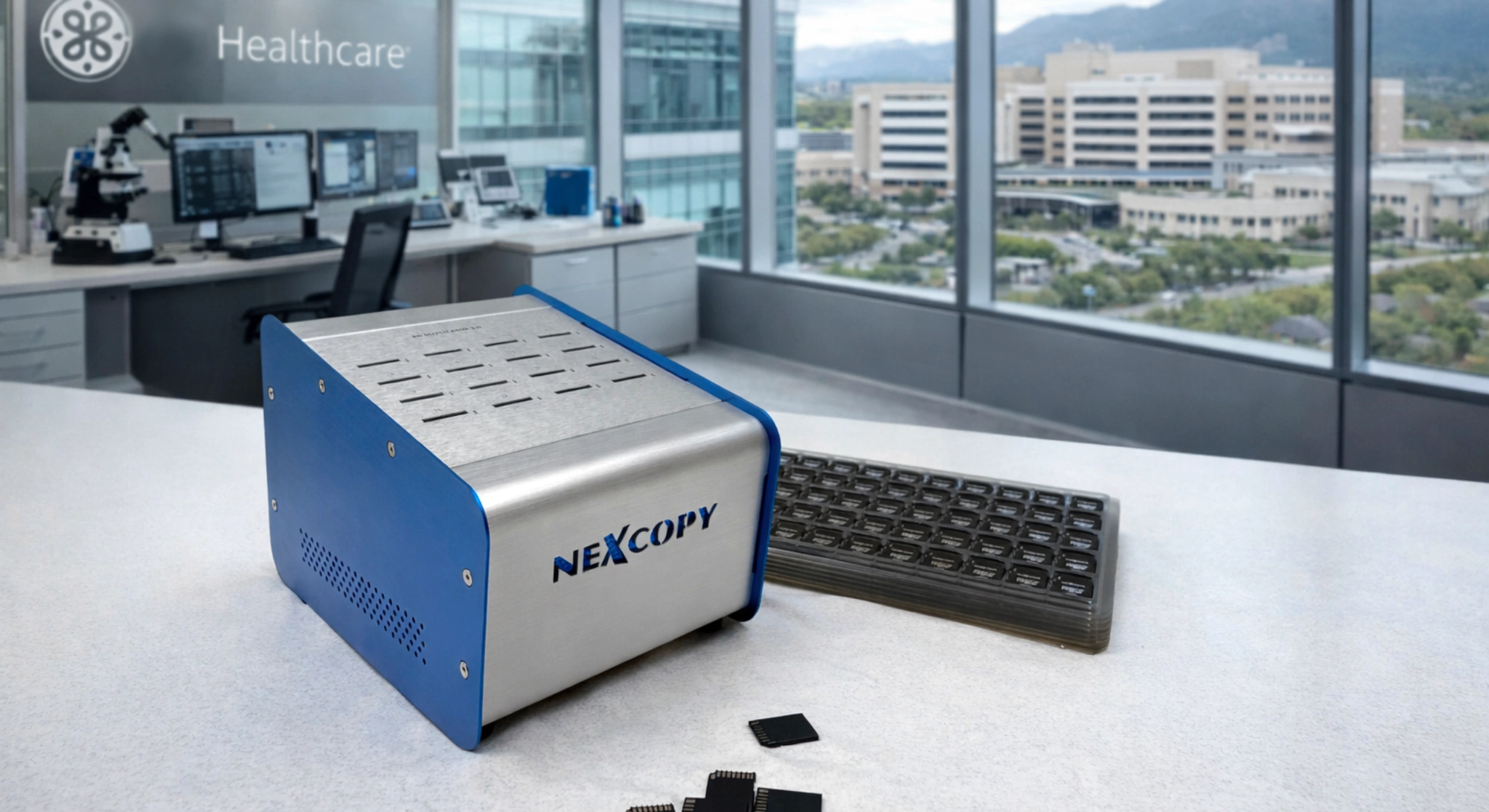
Nexcopy SD card duplicators are built for organizations that require reliable, repeatable duplication of SD media without relying on operating system file copy behavior. These systems write data directly to flash memory using controlled hardware workflows.
Nexcopy offers both advanced PC-based systems for detailed job configuration and reporting as well as high-speed standalone duplicators designed for high-volume production efficiency.
What is an SD card duplicator?
An SD card duplicator writes data directly to SD media at the hardware level, bypassing standard operating system copy processes. This method ensures predictable behavior, consistent performance, and identical results across large batches of SD cards.
These systems are essential for manufacturing, device provisioning, and regulated environments like gaming, medical, and kiosk platforms where interchangeability and validation are critical.
The SD Card Feature Comparison
| Detailed Feature Set | SD160PC | SD115SA | SD131SA |
|---|---|---|---|
| System Architecture | |||
| Number of Targets | 16 | 15 | 31 |
| Standalone Operation | — | ✓ | ✓ |
| PC Operation | ✓ | — | — |
| Copy Modes & Controller Functions | |||
| File Copy / Copy Add | ✓ | — | — |
| Device Copy | ✓ | ✓ | ✓ |
| Unique Data Stream / Imaging | ✓ | — | — |
| Read/Program CID Values | ✓* | — | — |
| Controller-Level Write Protection | ✓* | — | — |
Current SD Card Duplicator Models
These models represent Nexcopy’s current-generation SD duplication platforms, designed for modern production and deployment requirements:
- SD Card Duplicator – SD160PC
16-target PC-based system featuring CID reading/programming and controller-level data locking. - SD Card Duplicator – SD115SA
15-target standalone system optimized for high-speed industrial imaging and PC-free operation. - SD Card Duplicator – SD131SA
High-capacity 31-target standalone duplicator designed for scalable, volume-driven production.
*Programming CID values and controller-level write protection requires Nexcopy-qualified media for validation. Reading CID values can be performed on any standard SD card.
Form Factor Notice: This category outlines hardware systems engineered specifically for full-size, standard Secure Digital (SD) form factors. For micro-sized memory cards utilized in embedded platforms or mobile instrumentation, see our dedicated microSD Card Duplicator Systems section.
Frequently Asked Questions Regarding Full-Size SD Card Duplication
1. Can microSD cards be used in a standard full-size SD card duplicator?
While standard full-size SD slots can technically accept microSD media via passive mechanical adapters, doing so introduces significant risks into high-speed production environments. Physical adapters add extra mechanical contact interfaces that can result in intermittent signal dropouts, data verification failures, and premature wear on the master system. For sustained commercial workflows involving smaller form factors, deploying a dedicated microSD card duplicator with native micro-slots is highly recommended.
2. Why do industrial, medical, and aviation platforms continue to rely on full-size SD cards?
Standard full-size Secure Digital (SD) card structures offer distinct physical advantages over micro-variants, including thicker mechanical housings, greater surface area for thermal dissipation, and an integrated physical read/write protection switch. These structural properties make full-size cards vital for reducing data corruption caused by heavy operational vibrations, wide thermal fluctuations, and physical handling inside embedded device bays, machinery, and automotive instrument clusters.
3. Do standard Nexcopy SD duplicators replicate multiple file system partitions?
Yes. Utilizing our advanced PC-based platforms (such as the SD160PC) and executing a low-level binary image copy (Device Copy), operators can clone the entire storage landscape bit-for-bit. This process accurately duplicates multi-partition schemes, Master Boot Records (MBR), GUID Partition Tables (GPT), unallocated hidden sectors, and custom Linux or proprietary real-time operating system (RTOS) file architectures identically across every target socket simultaneously.
4. What is the operational difference between Standalone (SA) and PC-Based SD duplicators?
Standalone (SA) duplicators operate as self-contained units with internal binary processors, executing lightning-fast bit-for-bit image copies using a simple push-button interface—ideal for rapid, high-volume production lines. PC-Based systems (like the SD160PC) connect to a Windows workstation running our specialized Drive Manager software, unlocking advanced capabilities such as unique data streaming, data collection extraction, automated verification logs, and controller-level programming variables (CID/Write Protection).
5. Does the duplication process copy or modify the Card Identification (CID) register?
By default, a standard binary copy duplicates user data and partition tables but leaves individual card registers intact. Reading CID registers can be executed on any standard card. However, writing or customizing the manufacturer register values (CID programming) is a controller-level modification. Achieving successful CID programming requires specific vendor-approved controllers with in the media to support CID and write protect functions.
6. Can Nexcopy SD duplicators handle both SDHC and SDXC card specifications?
Yes. Nexcopy duplication hardware handles the low-level signal signaling across various standard card classifications, supporting both SDHC (Secure Digital High Capacity, 4GB to 32GB) and SDXC (Secure Digital Extended Capacity, 64GB up to 2TB) media profiles. Because our hardware operates directly at the raw flash layer during low-level device copying, formatting limitations (such as FAT32 vs. exFAT boundaries) do not restrict the system’s sector cloning capabilities.
7. How does Nexcopy ensure data integrity across large production batches?
Nexcopy hardware utilizes a hardware-verified bit-for-bit comparison pass. After writing binary sequences to target media, the system reads the data back from each individual socket and validates it against the master image down to the byte layer. This verification runs completely independently of operating system file-caching buffers, ensuring that physical write errors, bad sectors, or slow flash controller faults are instantly flagged and isolated before shipment.
Get the Right SD Card Duplicator for Any Project
Organizations evaluating SD card duplication systems for production imaging, device provisioning, or secure distribution can request technical guidance before deployment. Nexcopy supports workflow qualification, platform selection, and procurement planning to ensure your system aligns with your specific volume and verification needs.