


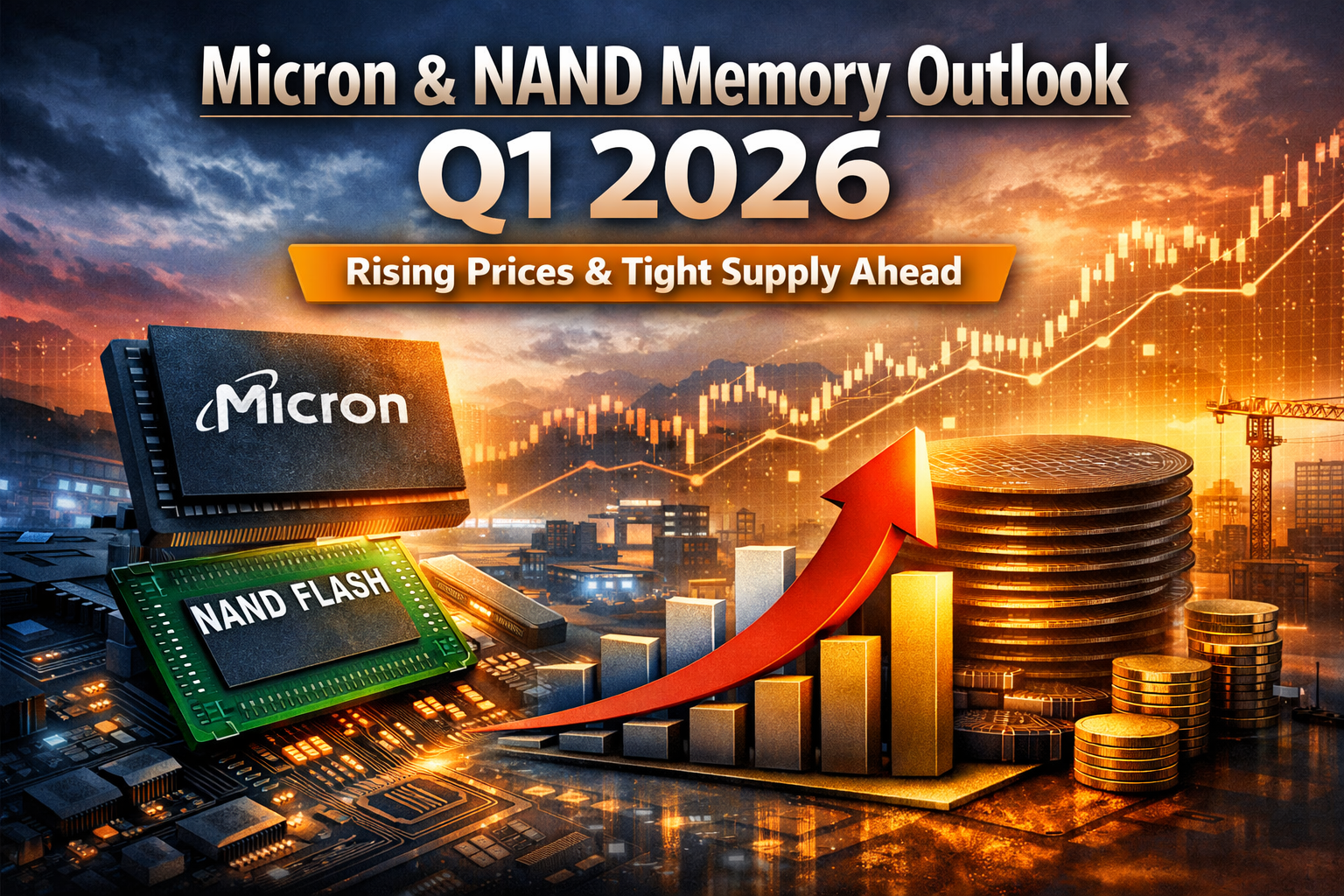
NAND memory pricing is entering a volatile phase in early 2026, and Nexcopy clients should expect cost uncertainty, tighter supply, and reduced spot-market flexibility.
This update is based on analysis and reporting published by GetFlashMemory.info, which tracks NAND market conditions, supplier behavior, and pricing signals across the global flash memory supply chain. Nexcopy is sharing this summary to help customers understand how these trends may impact product pricing, lead times, and procurement planning in Q1 2026.
According to GetFlashMemory.info, the NAND market is no longer in recovery mode. After more than a year of inventory correction and cautious production, suppliers have regained pricing leverage. As Q1 2026 begins, NAND availability is tightening, supplier discipline is holding firm, and price increases are already working their way through the channel.
Why NAND pricing is becoming unpredictable
The volatility expected in Q1 2026 is driven by a deliberate imbalance between supply and demand. Major NAND manufacturers — including Micron, Samsung, and SK hynix — spent much of 2024 and early 2025 reducing output, delaying fab expansions, and focusing on yield optimization rather than volume growth.
Those actions successfully cleared excess inventory, but they also removed the safety buffer that historically softened short-term demand swings. As a result, even moderate demand increases now translate into faster price movement and reduced negotiating flexibility for buyers.
GetFlashMemory.info notes that demand has remained stronger than many forecasts anticipated, particularly from enterprise storage and AI-related infrastructure. While AI is often associated with DRAM, NAND plays a critical role in data storage, training datasets, checkpoints, and high-capacity SSD deployments — all of which are absorbing wafer supply.
Micron’s strategy reinforces near-term supply constraints
A key data point highlighted by GetFlashMemory.info is Micron’s long-term capacity planning. Micron recently announced a major multi-billion-dollar NAND investment in Singapore, a move that will significantly expand output — but not until the second half of 2028.
That timeline is important. It signals that Micron does not expect near-term oversupply and is intentionally avoiding capacity additions that could soften pricing in 2026. For Q1 buyers, this means current price pressure is unlikely to ease due to new production coming online.
Instead, suppliers are prioritizing higher-margin NAND products, particularly enterprise-grade TLC and QLC used in data centers. This upstream prioritization reduces availability for consumer and removable media applications, even if end-market demand remains stable.
What is actually getting more expensive
Not all NAND categories are increasing at the same rate, but the overall trend is upward. Enterprise SSD NAND is leading price increases, and those increases cascade downstream as wafers are redirected away from lower-margin uses.
For products such as USB flash drives, memory cards, and embedded flash, the impact may show up as:
- Higher component pricing compared to late-2025 contracts
- Reduced spot availability for certain densities
- Longer lead times during peak ordering periods
- Greater emphasis on forecast commitments from suppliers
As GetFlashMemory.info points out, price volatility does not necessarily mean constant increases week-to-week — but it does mean less predictability and fewer opportunities to rely on last-minute sourcing to control costs.
Why suppliers are holding firm on pricing
This pricing environment is not accidental. NAND suppliers are intentionally avoiding the boom-and-bust cycles that previously led to prolonged price collapses. Capacity discipline, margin protection, and selective customer allocation are now core strategies.
The result is a market where volume alone no longer guarantees better pricing. Suppliers are increasingly willing to walk away from low-margin business, particularly when demand from enterprise and strategic customers remains strong.
GetFlashMemory.info also notes that lean inventories amplify risk. Any external disruption — logistics issues, geopolitical events, or unexpected demand spikes — could quickly translate into sharper price swings.
What this means for Nexcopy customers
For Nexcopy clients, Q1 2026 should be treated as a planning quarter rather than a wait-and-see moment. Cost assumptions based on late-2025 NAND pricing may no longer be reliable, and product pricing models should account for continued volatility.
Customers with fixed pricing commitments, long sales cycles, or regulated delivery requirements should consider securing supply earlier and avoiding dependence on spot-market relief. As NAND prices rise, predictability and consistency become more valuable than chasing short-term cost savings.
This environment also favors controlled, professional-grade flash solutions. When raw NAND pricing tightens across the board, differentiation shifts away from lowest-cost components and toward reliability, traceability, and consistent device behavior — areas that matter most in enterprise, medical, and government deployments.
Looking beyond Q1 2026
GetFlashMemory.info concludes that most analysts expect NAND pricing to remain firm throughout 2026, with major capacity expansions delayed until 2028 or later. Short-term fluctuations may occur, but the era of excess NAND supply appears to be behind us for now.
For Nexcopy customers, the takeaway is straightforward: expect uncertainty, plan early, and assume upward pressure rather than relief. Q1 2026 is a clear signal that NAND pricing dynamics have shifted — and procurement strategies should shift with them.
Source: GetFlashMemory.info — Micron and NAND Memory Outlook for Q1 2026